“I didn’t know that.”
“I wasn’t informed.”
These are some of the most frustrating words I hear when managing a global team.
When Japanese team members and local partners come together for a project kick-off meeting, unexpected situations sometimes arise.
At the end of one meeting, a local colleague suddenly asked a representative from the Japanese team to give a closing remark.
He looked surprised and slightly embarrassed by the unexpected request, as it had not been included in the meeting agenda.
He managed to deliver a short speech, however after the meeting, he said to me with clear frustration:
“I wasn’t prepared for that speech. It wasn’t in the agenda, was it? Did you know I would be asked to speak? I wish I had been informed in advance.”
I told him that I hadn’t known either. The request had simply been improvised by the local partner.
In situations like this, the frustration often comes from being asked to respond to something that was not communicated beforehand.
—
In another situation, Japanese colleagues often request that local partners share their presentation slides in advance of a meeting.
They want to understand what will be discussed ahead of time, so they can prepare and ask relevant questions.
These requests typically start about 10 days before the meeting.
Meanwhile, local partners often finalize their presentation slides just one or two hours before the meeting.
Because of this gap, I frequently receive emails from Japanese colleagues such as:
“Could you please share the presentation slides from all local speakers?”
I sometimes ask local partners to send their slides earlier.
However, they are often not ready, and some become frustrated by repeated requests.
Some even say:
“If they review my slides in advance, we don’t really need a meeting.”
—
Japanese team members feel frustrated because they don’t know what will be discussed until the meeting itself.
Local partners feel frustrated because they are pressured to submit materials in advance.
And I find myself caught between these two expectations.
—
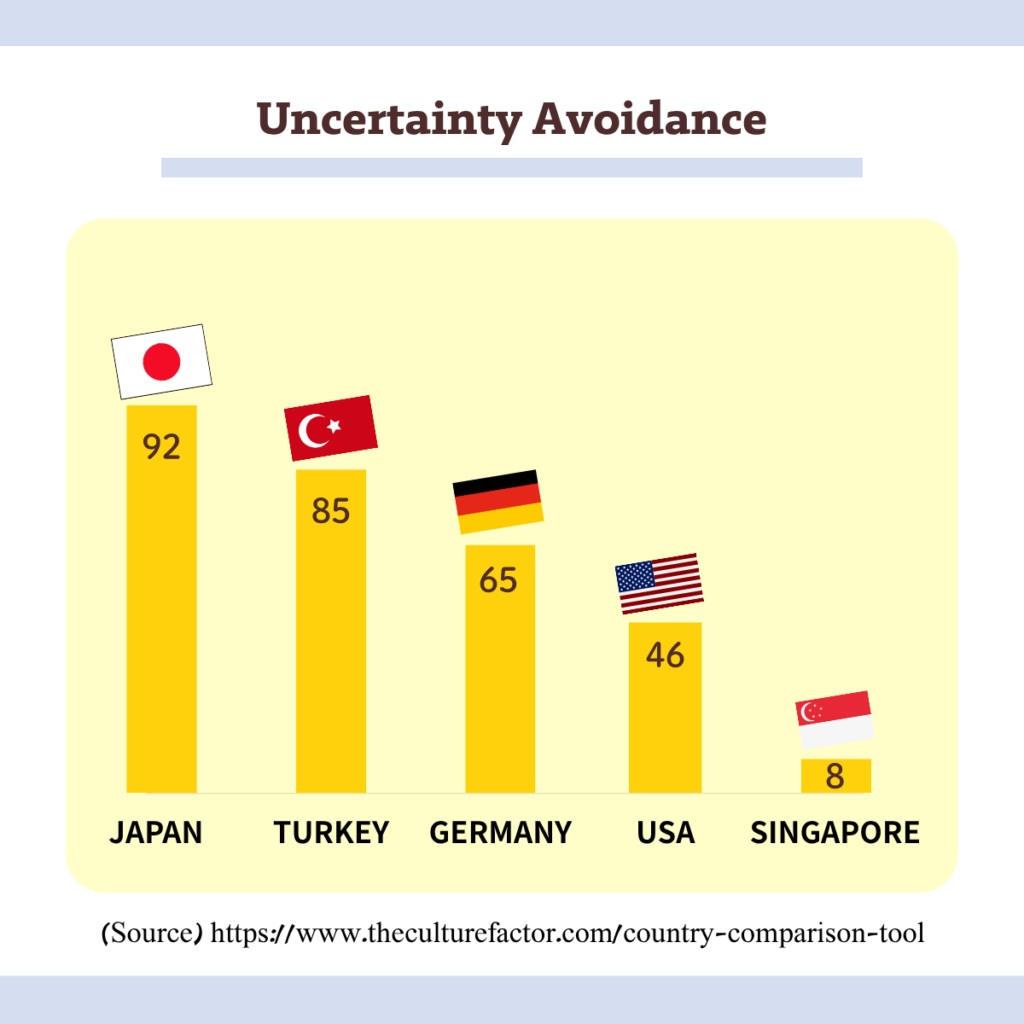
This difference can be partly explained by the concept of “Uncertainty Avoidance,” which refers to how strongly people prefer predictability and feel uncomfortable with ambiguity.
The image below shows global rankings of uncertainty avoidance, and Japan ranks among the highest.
In other words, Japanese professionals tend to prioritize predictability and clarity, and may feel stressed when situations are unclear or unexpected.
On the other hand, they can be highly effective when everything is well prepared and structured.
—
Looking at these differences, I am reminded that what is considered a “strength” in one context can also appear as a “weakness” in another.
And this applies not only across countries, but to all of us working in global environments.
How do you navigate this gap in expectations within your global team?